A visit to the Children Cancer Centre
Last December, I visited the Children Cancer Centre in Kathmandu with my family. After a brief search in a remote neighborhood, we were greeted by Anamika, who immediately took us into the centre.
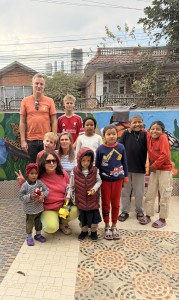
What struck me immediately was the simple surroundings. A small stone courtyard, a ride-on car, and a colorful mural of animals that still gave the impression that children live here. No playground equipment, hardly any toys, and on one side, the grounds were open due to construction work.
I was introduced to all the children and their parents. And Anamika took me to the room of Rekha and her mother. Rekha is 10 years old and has leukemia. I stepped into the small room. There were two single beds. One for the child, the other for the parent(s). The walls were brightened up with children's drawings. Rekha and her mother sat down on one of the beds, and I knelt down beside them. Rekha's mother began to tell me that they had come to Kathmandu for treatment once before but had to return home. The treatment wasn't finished yet, but they had no choice; the money had run out. And although I can't understand a word of it, I hear the despair in her voice. She starts talking louder and louder. She tells me that her sister offered her money to go back and then they got the chance to stay at the center. How grateful she is for this.
And while the mother tells me this, Rekha sits next to her laughing, visibly uncomfortable and shy. Then her mother takes off her hat to show that she has almost no hair. I see shame and discomfort on her face. I pretend to put her hat back on and promise not to take photos without her hat. She smiles at me, but I also see that she would rather not be here. She just wants to go outside, play with the other children. Just join in, just be a child.
Later, I spoke with several parents. Their stories were heavy, but above all, honest. About illness, uncertainty, and difficult choices. Some have sold their jewelry, land, or livestock to be able to be here. There are often more children who also need to eat, need to go to school; the land is needed to live off, to work on. What do you choose? Time and again, that one dilemma: giving up everything for treatment, or going back without hope.
I see my children playing with the children from the centre. The ease with which they make contact—a ball, a toy car, they don't need anything else. They laugh and have fun. It is beautiful to see how pure and uninhibited that happens, children finding each other, detached from everything else that is going on. They feel no inequality, but when I look at them, I know that it is there nonetheless.
Acknowledgements and Partners